

Practitioner’s guide for startups and marketers that will enable you to live through zero-click searches, get AI citations, and turn generative searchers into paying customers.
The truth isn’t simple. It’s not that SEO is dead. It’s not that nothing has changed. SEO in the age of AI Overviews isn’t, about throwing away strategies. It’s about building on them. It’s about adapting. Businesses that understand how AI Overviews work. How they pull information how they rank sources how they decide what to show. Are the ones that will stay visible. Others risk falling unnoticed and unchosen. This article explains what AI Overviews really are. It shows how they’re reshaping how people search.. Most importantly it tells you what businesses must do to stay ahead.
What Are AI Overviews?
I find that when one types a question in Google today, one is less likely to get ten blue links in the first place. One gets an AI generated overview at the top of search results answering the user’s query even before they have clicked anything.
AI Overviews refer to AI generated overviews that pop up at the top or near the top of search results in order to directly answer a users’ query by pulling information from different sources.
Of users clicking through several websites in order to make sense of the answer, the AI behind the search engines does the job of finding the relevant information online and summarizing it into an answer.
What Every Business Leader Must Know Right Now
01 Zero-Click Search Sets The New Norm
More than 60 percent of all search queries don’t result in clicks anymore. If you’re getting your traffic just by answering informational queries, you’re leaking from your funnel. Go commercial right away.
02 Ranking #1 Does Not Mean Traffic
AI Overviews move organic rank #1 below by 800+ pixels. Not being referenced in the AI answer box will reduce your CTR by 30%-48%.
03 AI Citations Prefer Condensed 50-Word Capsules
While 84% of cited sources are within the top 10, Google pulls from pages that provide concise 45- to 60-word answer capsules immediately below question headers.
04 Your Sole True Moat Is Information Gain
Google Patent US10795944B2 demotes recycled content. Publish unique data, customer success stories, and controversial opinions that AI cannot create.
05 Your Brand Footprint Needs to Extend Past Your Website
Gemini and Perplexity leverage their learnings from Reddit, YouTube, podcasts, and customer feedback. Without your brand making noise on the internet, AI engines will never suggest your website.
Why the 10 Blue Links Are Dying
It was all straightforward for 25 years—create valuable content, get indexed by Google, get ranked via ten blue links, and bring interested parties to your site.
This arrangement has been scrapped. Now, with Google AI Overviews powered by Gemini, Google is evolving into an answer engine which will directly answer queries on its results pages.
Stop obsessing over vanity impressions. We have seen client websites lose 30% of top-of-funnel definition traffic, yet their qualified sales calls grew by 45% because they targeted high-intent decision queries and won the AI citation cards.”
An AI Overview when triggered consumes 800 to 1,200 vertical pixels on the page. When this happens on a smartphone device, the much desired rank #1 position gets pushed beneath the fold completely. Even if you have rank #1, then users would have to scroll beyond an AI summary, paid advertising, and conversational responses.
The Anatomy of an AI Citation: Who Wins the Link Cards?
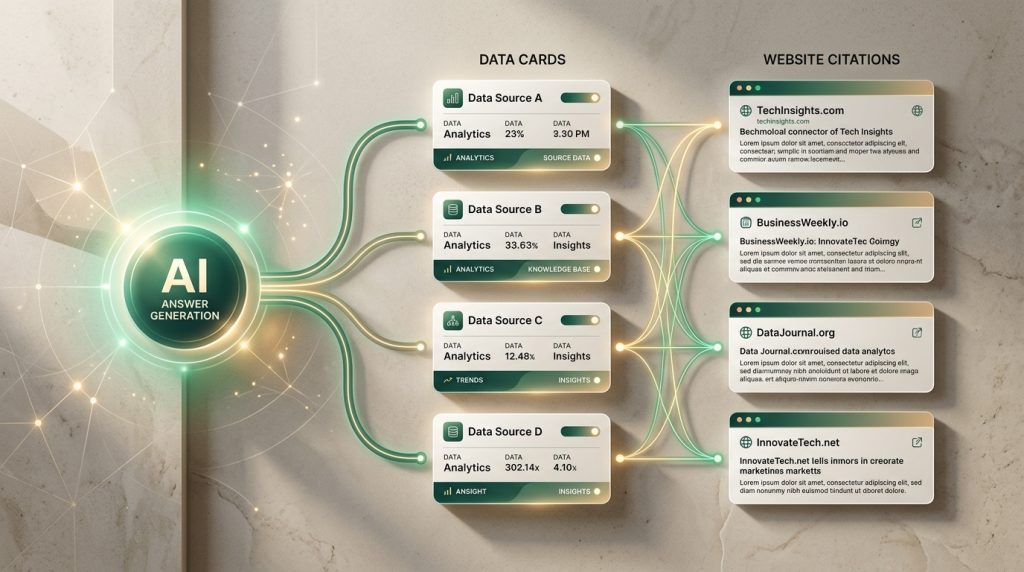
Retrieval-Augmented Generation (RAG) — Linking verified website entities into AI citation cards.
When a searcher clicks one of these citation cards, they aren’t a casual browser looking for a definition—they already read the summary. They click through because they need the deep implementation blueprint, the downloadable calculator, or the expert who can execute it.
At Grownversion, we’ve found that while raw click volume on top-of-funnel posts has softened, the visitors who click through from AI citation cards convert at 2.5x to 3.8x higher rates into pipeline leads.
The Trinity of Search: SEO vs. AEO vs. GEO
Pillar 1
SEO
The Foundation: Crawlability, sub-second speed, semantic HTML5, and topical authority that drives page-one placements.
Pillar 2
AEO (Answer Engine Optimization)
The Syntax: 50-word answer capsules, step-by-step instructions, and tables that are parsed by bots in microseconds.
Pillar 3
GEO (Generative Engine Optimization)
The Reputation: Offsite brand mentions from Reddit, podcasts, and other media to make LLMs suggest your name
| Dimension | Old SEO | AI Overview Era | Business Impact |
|---|---|---|---|
| Primary Objective | Rank #1 on a list of 10 blue links | Win citation chips inside the AI summary box | Protects your pipeline against zero-click traffic collapse |
| Keyword Mindset | Target exact-match search volume with single-topic pages | Answer multi-layered conversational questions and topic clusters | Attracts high-intent buyers who are ready to make decisions |
| Content Structure | Lengthy 3,000-word fluff designed to inflate dwell time | Modular 50-word answer capsules, clear tables, and quick takeaways | Allows AI scrapers to digest and quote your data in under 200ms |
| Value Proposition | Rewrite the top 3 ranking results with slightly more words | Information Gain: original experiments, client numbers, and contrarian insights | Builds a defensible moat that ChatGPT cannot replicate |
| Conversion Path | Generic popups and newsletter bars | Decision-readiness audits, interactive calculators, and direct consulting | Turns the searchers who skip the AI summary into closed contracts |
The 5 Core Pillars Businesses Must Implement Now
01 Information Gain & Proprietary Data
Stop regurgitating other people’s work; share your original insights
Key Insight: No original data = no citations from AI. Provide your unique data, benchmarks, or field studies.
Large language models are expert summarizers. When your blog post simply restates the same 5 points that everyone else states, Google will summarize your competition’s content with more domain authority and disregard yours. In order to get cited, you need to provide some kind of new data, price range, or client testing.
Action Plan:
Add internal client stats, price range, and results in every key content piece.
Fact Check:
US patent 10795944B2 by Google grades pages based on the amount of ‘novel information’ in relation to what the user has already seen.
02 AEO Answer Capsules & Modular Architecture
Organize your answers so that AI scrapers can read and cite you in seconds.
Takeaway: Give 50 words of a direct answer right under each subhead. Forget the build-ups.
AI search engines are impatient readers. Stop burying your conclusion underneath 700 words of intro. Start with 45-60 word declarations under your H2 subhead, then follow it up with a check list or comparative table.
Action Step:
Use a 50-word answer block and check list/table for all informational headers.
Validation:
71% of AI Overview quotations are extracted from neat paragraph blocks right under descriptive headers.
03 Entity-Based Semantic SEO & Topical Graphs
Position your company, founder and expertise into Google’s Knowledge Graph
Quick Summary: Keywords are text, but entities are objects. Integrate yourself and your organization straight into Google’s Knowledge Graph.
Classic SEO used to be all about keyword matching. Now, AI-powered search relies on identifying entities: who you are, what you excel at, and how trustworthy you are. Without structured entity information, Google won’t be able to consider you a source of truth with certainty.
Immediate Actions:
Use schemas for Organization, Person, and Service with SameAs verified from LinkedIn, Crunchbase and media outlets.
Verification:
Websites that have their entities verified get 3.4 times more citations in Gemini, Copilot and Perplexity than those with keyword stuffing.
04 Undiluted E-E-A-T Reinforcement
Experience from real humans is the perfect remedy for AI-generated garbageQuick Takeaway: AI content is always untrustworthy. Feature human experts with skin in the game.
The Google Quality Raters Guidelines make sure that Experience comes first and foremost. Unfiltered 2,000-word articles generated using ChatGPT have zero trust value. You need human experts, quotes from them, honest case studies, and clear credentials.
Quick Fix:
Include credentials from authors, confirmed LinkedIn profiles, proof of clients paying you, and clearly marked review dates.
Testimonials:
Websites which switched from fake bylines to verified experts saw their visibility increased by 22% on average after core updates.
05 Off-Site Brand Footprint & Digital PR
AI models crawl the wider web to see who real people recommend
Generative AI engines don’t evaluate backlinks in a vacuum. They analyze conversational sentiment across Reddit, Quora, industry forums, podcasts, and reviews. When a user asks an AI ‘Who is the best partner for B2B email funnels?’, the AI recommends whoever the community vouches for.
Information Gain: Google Patent US10795944B2
Google was awarded a landmark patent titled “Contextual Estimation of Information Gain.” In simple English: Google measures the mathematical novelty of your content compared to what the searcher has already read elsewhere.
If nine competitors post the same generic advice, Google gives them an Information Gain score near zero. But if your page includes proprietary cost breakdowns, internal benchmarks, or hands-on tests, Google awards a high multiplier and puts your citation in the AI box.
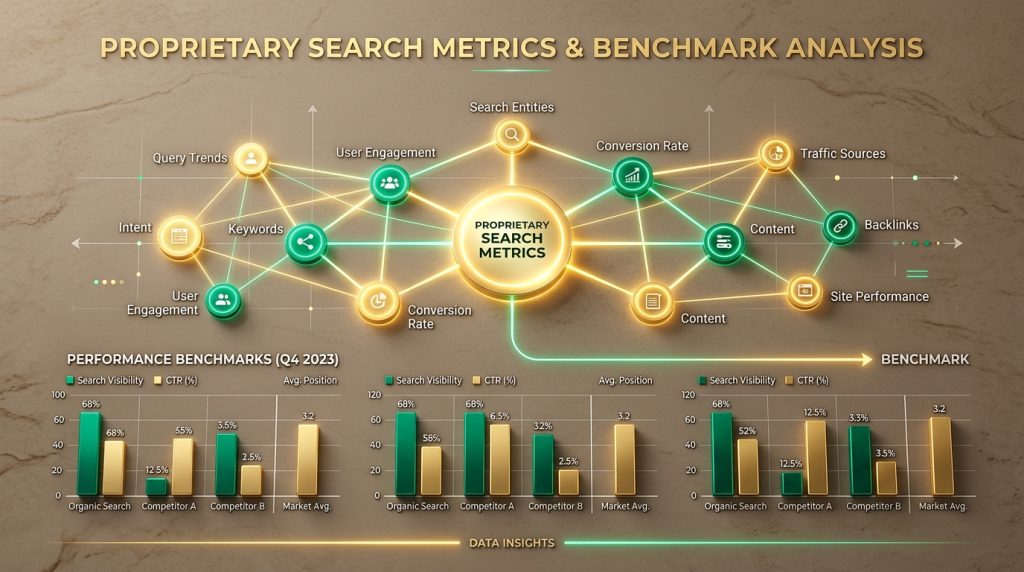
Proprietary Data Vectors — How Google differentiates original benchmarks from recycled content.
Grownversion Growth Infrastructure
Grownversion brings SEO, Content Marketing, Social Media Marketing, Email Marketing, and CMS Development together to create a complete digital growth system for your business.
1. AI-Age SEO & AEO Infrastructure
We improve your content strategy to help your business answer user questions across traditional search and AI-powered search experiences.
Our Core Focus
- Topical authority and semantic topic mapping
- Answer-focused and easy-to-understand content
- Conversational keyword research
- Relevant entity and structured data implementation
2. Content Marketing & Original Research
We create original and valuable content using your business knowledge, customer insights, research, and real-world experience.
Our Core Focus
- Industry reports and original research
- Thought leadership content
- Business insights and case studies
- Interactive calculators and useful resources
3. Social Media Marketing & Digital PR
We help your brand improve its online presence through social media, relevant digital communities, and public relations.
Our Core Focus
- Social media content and campaign planning
- Brand awareness and audience engagement
- Digital PR opportunities
- Lead generation through social platforms
4. Email Marketing & Customer Nurturing
We help businesses build stronger customer relationships through useful email communication, automation, and nurturing campaigns.
Our Core Focus
- High-value lead magnets and resource kits
- Welcome and onboarding email sequences
- Newsletter planning and curation
- Customer nurturing and retention campaigns
5. High-Performance CMS Development
We develop clean, responsive, and user-friendly websites with a focus on website performance, accessibility, and search-friendly structure.
Our Core Focus
- Modern HTML5 and CMS development
- Mobile-friendly website structure
- Website speed and performance improvements
- Semantic HTML and structured data support
Ready to Grow Your Business?
Let Grownversion help you build a practical digital marketing strategy. Schedule a growth strategy call to discuss your website, content, competition, and business goals.
Schedule Strategy CallFARQUENTLY ASKED QUESTION (F.A.Q)
However, no, not the lazy SEO from 2018. Writing 800-word generic articles ("definition article about what is CRM") will not bring traffic because Google will answer this question for you directly. But SEO has developed into the game of Topical Authority, Information Gain, and Entity Building, and those companies that have mastered it get high-intent leads who really need professional execution.
Telemetry from industry sources shows that AI Overviews are present in about 15%-25% of searches, mostly in informational, comparative, procedural, and commercial research searches. Navigational searches ("Nike login") and local searches use the regular listing format, but Google is consistently pushing forward the boundaries of AI-powered answers.
Google’s search algorithm searches for three main criteria: Firstly, Top-10 organic presence for relevant sub-queries (84% match rate). Secondly, High Information Gain (original data, client testing data, unique viewpoints). Thirdly, Modular answering format (45-60 word long answer boxes immediately below descriptive headings).
Currently, Google ties AI Overview retrieval directly to standard Googlebot. If you block Googlebot in robots.txt, your website disappears from organic search entirely. The smart approach is to provide crisp answer capsules to win the citation, while gating deep implementation tools and proprietary blueprints to capture the lead.
Stop paying for 30 generic AI articles a month. Instead, invest that budget into one original research report per quarter, technical schema engineering, and podcast or community digital PR. High-authority assets deliver compound ROI, whereas generic content delivers diminishing returns.
AEO (Answer Engine Optimization) is on-page syntactic structure: organizing content into answer capsules, lists, and schema so bots can extract answers. GEO (Generative Engine Optimization) is off-page authority: building your brand presence across Reddit, YouTube, reviews, and press so LLMs naturally recommend your company.
Ready to turn more visitors into customers?
Discover opportunities to improve your website experience, strengthen your messaging, and create a clearer path from visitor to customer.
Get More Information →