
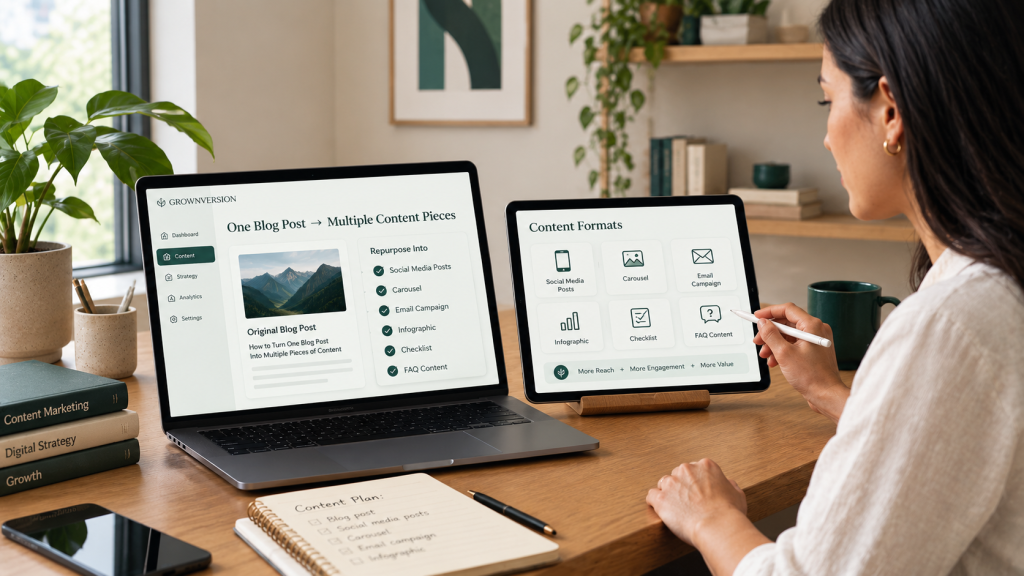
How to Turn One Blog Post Into Multiple Pieces of Content

Creating high-quality content takes time. But one strong blog post does not have to be used only once. With the right content marketing strategy, you can turn one detailed article into multiple useful pieces of content for different platforms.
A single blog post can become social media posts, carousel content, short videos, email content, FAQs, checklists, infographics and even an entire content series.
Content repurposing means taking valuable information from an existing piece of content and adapting it into different formats and platforms. One detailed blog post can produce multiple social posts, videos, emails, carousels, FAQs, checklists and other content assets.
What Is Content Repurposing?
Content repurposing is the process of taking an existing piece of content and transforming its useful ideas into different formats.
Instead of creating every social post, email or other content from scratch, you can use your existing blog content as the foundation for a larger content system.
Why Should You Repurpose Your Blog Content?
1. Save Time
You already have the research, ideas and information inside your original blog post. Repurposing allows you to reuse that work in different formats.
2. Reach Different Audiences
Some people prefer reading articles, while others consume short videos, carousels, emails or social media posts.
3. Increase Content Distribution
A single topic can appear across multiple channels without requiring an entirely new idea every time.
4. Strengthen Your Brand Message
Repeating useful ideas in different formats can help your audience understand your expertise and messaging more clearly.
5. Support SEO
Useful supporting content can help build topical depth around important subjects. Explore our SEO services to learn more.
6. Improve Social Media Consistency
A strong blog can provide several social media ideas instead of forcing you to create completely new topics every day.
7. Extend the Life of Your Content
Good content can continue generating value long after the original article has been published.
How Many Pieces of Content Can You Create From One Blog Post?
There is no fixed number. It depends on the length, depth and usefulness of the original article.
A comprehensive blog post can potentially become social posts, carousel slides, email content, FAQs, checklists, infographic points and additional articles.
How to Turn One Blog Post Into Multiple Pieces of Content
Step 1: Identify the Main Topic
Start by identifying the central topic and the main problem your article solves.
Step 2: Break the Blog Into Sections
Each major section can become an individual content idea.
Step 3: Extract Key Insights
Look for statistics, tips, mistakes, examples, questions and actionable advice.
Step 4: Match Ideas With Platforms
Decide whether each idea works better as a social post, email, carousel, infographic or another format.
Step 5: Adapt the Message
Do not simply copy and paste the entire article everywhere. Adapt the content to the platform and audience.
Step 6: Add a Clear Call to Action
Each piece of content should have a relevant next step for the audience.
Step 7: Create a Distribution Schedule
Organize your repurposed content into a simple content calendar.

How to Turn a Blog Post Into Social Media Content
Your blog can become multiple social media posts. Some useful formats include:
- Tips
- Problems and solutions
- Common mistakes
- Checklists
- Questions
- Quotes and insights
- Myth vs fact posts
For more ideas, explore our social media marketing.
How to Turn a Blog Post Into a Carousel
A carousel can turn a detailed blog section into a simple visual learning experience. Each slide should communicate one clear idea.
| Carousel Slide | Content |
|---|---|
| Slide 1 | Main topic or hook |
| Slide 2 | The problem |
| Slide 3 | Key insight |
| Slide 4 | Practical tip |
| Slide 5 | Example |
| Slide 6 | Action step |
| Slide 7 | Call to action |

How to Turn a Blog Post Into Email Content
A blog post can also become an email campaign. You can use its main insight as the subject of a newsletter or divide different sections into a short email series.
For businesses looking to build relationships with leads, explore our email marketing.
How to Turn a Blog Into an Infographic
Identify the most important statistics, steps, processes or comparisons from your blog. These can then be presented visually in an infographic.
How to Turn a Blog Post Into FAQ Content
Questions already answered inside your article can be transformed into FAQ content. This can make information easier for users to scan and understand.
How to Turn a Blog Into a Checklist
Convert actionable advice into a simple checklist. This works particularly well for tutorials, processes, audits and step-by-step guides.
How to Turn One Blog Into a Full Content Series
Instead of publishing everything at once, divide your main topic into several smaller content pieces. Each piece can focus on one specific question or problem.
Why You Should Not Post the Same Content Everywhere
Repurposing does not mean copying the exact same content across every platform. Each platform has different audience expectations and content formats.
The core idea can remain the same while the presentation, length, hook and call to action change according to the platform.
A Simple Content Repurposing Example
Imagine you publish a detailed article about improving website conversions. That one article could become:
- 5–7 social media posts
- 1 carousel
- 1 newsletter
- Several FAQ questions
- 1 checklist
- 1 infographic
A Simple Content Repurposing Workflow
- Publish the main blog post.
- Extract the most valuable ideas.
- Create social media posts.
- Create carousel content.
- Create email content.
- Add FAQs and checklists.
- Schedule and distribute everything.

How Content Repurposing Supports SEO
Repurposing can support a broader content strategy by helping businesses cover related questions and topics consistently.
The goal should not be producing content simply for volume. Every new piece should provide useful information and serve a clear purpose.
Common Content Repurposing Mistakes to Avoid
- Copying the same content everywhere.
- Creating content without a clear purpose.
- Ignoring platform-specific formats.
- Using weak hooks.
- Forgetting calls to action.
- Focusing on quantity instead of usefulness.
- Failing to track performance.
Which Parts of a Blog Post Should You Repurpose?
Look for the sections that contain the strongest practical value. These may include statistics, examples, step-by-step processes, mistakes, tips, questions and important insights.
How Often Should You Repurpose Content?
There is no universal schedule. The frequency should depend on your publishing capacity, audience and content strategy.
A Simple Content Repurposing Strategy for Small Businesses
Small businesses can start with one strong blog post every few weeks and turn each article into several smaller content pieces.
Combine this with a simple digital marketing strategy and a consistent publishing schedule.
How to Measure Your Repurposed Content
Track metrics that match the goal of each content format.
- Website traffic
- Engagement
- Click-through rate
- Email clicks
- Leads
- Conversions
Frequently Asked Questions
Suggested Internal Resources
Explore more Grownversion resources:
- Content Marketing Strategy
- SEO Services
- Social Media Marketing
- Email Marketing
- Digital Marketing Strategy
- Website Development
Conclusion
One high-quality blog post can become the foundation for an entire content system. Instead of constantly starting from zero, businesses can extract valuable ideas and adapt them into different formats.
The goal is not simply to create more content. The goal is to make valuable content work harder across the customer journey while keeping every format useful and relevant.
WORK WITH GROWNVERSION
Ready to turn more visitors into customers? Discover opportunities to improve your website experience, strengthen your messaging, and create a clearer path from visitor to customer.
Get More Information →