
AI-Powered Digital Advertising: What Businesses Need to Know in 2026
Artificial intelligence is changing how businesses plan, create, target, optimize, and measure digital advertising campaigns. The biggest opportunity is not simply using more automation—it is using AI to make better advertising decisions while keeping human strategy at the center.
Table of Contents
- How AI-Powered Digital Advertising Works
- Traditional vs AI-Powered Advertising
- How AI Is Changing Digital Advertising
- AI in Google, Meta & Social Advertising
- AI in E-Commerce Advertising
- Benefits of AI Advertising
- Challenges & Risks
- Practical AI Advertising Workflow
- Real-World Examples
- How Small Businesses Can Start
- Mistakes to Avoid
- Future of AI Advertising
- AI Advertising Framework
- Frequently Asked Questions
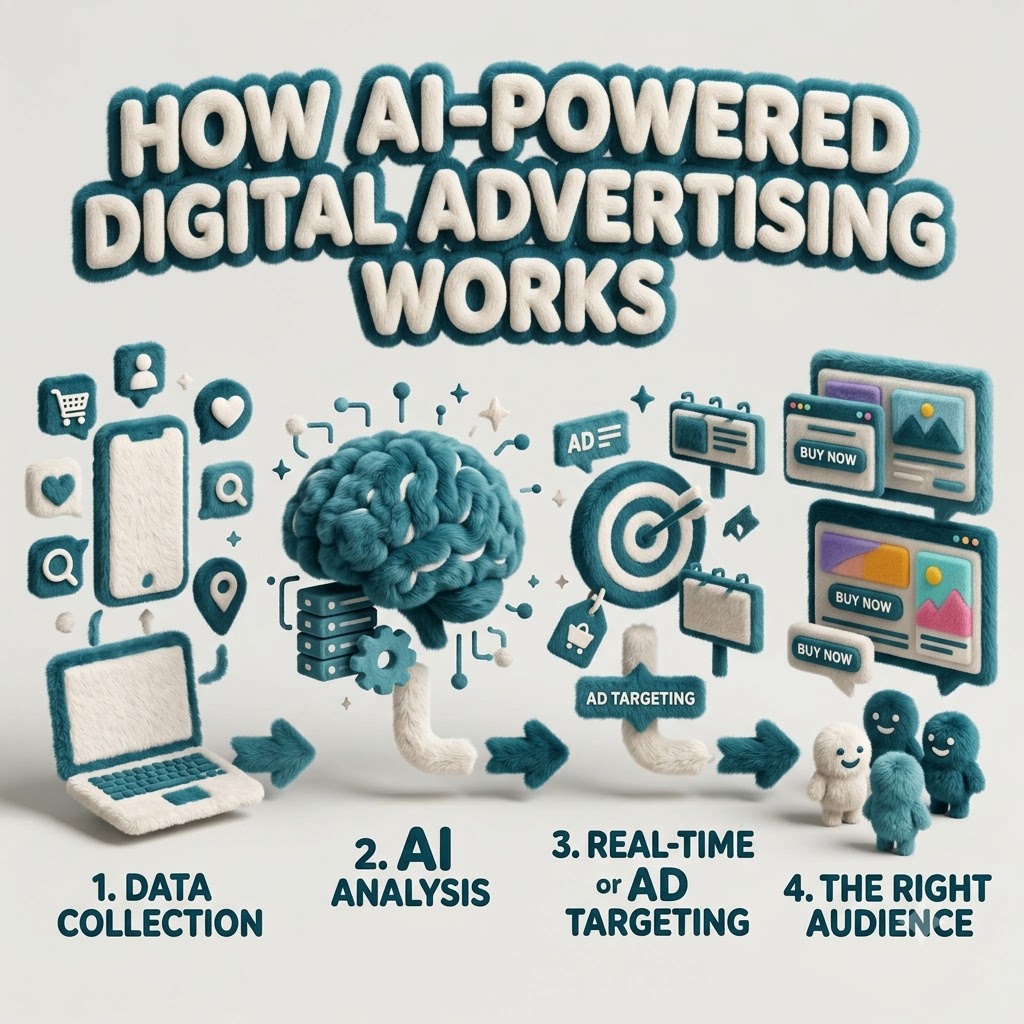
How Does AI-Powered Digital Advertising Work?
AI-powered advertising combines business data, customer signals, predictive models, automation, and continuous optimization to help advertisers make faster and more informed campaign decisions.
1. Data Collection
Advertising systems use relevant campaign and audience signals to understand customer behavior, interests, conversions, and interactions.
2. Signal Analysis
AI processes large amounts of information and identifies patterns that may be difficult to evaluate manually.
3. Prediction
Predictive systems estimate which audiences, placements, messages, and actions are more likely to generate desired results.
4. Decision Making
AI can recommend or automatically adjust targeting, bidding, placements, creative combinations, and campaign settings.
5. Ad Delivery
Campaigns can dynamically deliver ads to relevant audiences and optimize delivery according to campaign objectives.
6. Measurement & Optimization
Performance data feeds back into the system, allowing campaigns to be tested and improved continuously.
Traditional Digital Advertising vs AI-Powered Advertising
| Area | Traditional Approach | AI-Powered Approach |
|---|---|---|
| Audience Targeting | More manual audience selection | Automated audience discovery and prediction |
| Bid Management | Manual or rule-based adjustments | Automated bidding based on campaign signals |
| Creative Testing | Limited combinations tested manually | Multiple combinations can be tested at scale |
| Personalization | Often based on predefined segments | Dynamic personalization using available signals |
| Optimization | Periodic manual optimization | Continuous automated optimization |
| Data Analysis | Human-led analysis | AI-assisted pattern and trend analysis |
| Scalability | Limited by manual workload | Automation enables larger-scale management |
| Human Role | High operational involvement | More focus on strategy, creativity and decision-making |
How AI Is Changing Digital Advertising
AI-Powered Audience Targeting
AI can analyze audience signals and identify patterns that help advertisers reach people more likely to respond to a campaign.
Automated Bidding
Automated bidding can adjust bids according to campaign objectives, available signals, competition, and expected performance.
AI-Generated Ad Copy
AI tools can assist with headlines, descriptions, variations, hooks, calls to action, and campaign messaging.
AI-Generated Creative Ideas
AI can support the development of creative concepts, visual directions, layouts, and multiple advertising variations.
Dynamic Personalization
Advertising experiences can be adapted according to audience characteristics, behavior, intent, and campaign context.
Predictive Analytics
AI can help identify trends and estimate potential outcomes from historical and real-time campaign signals.
Automated Campaign Optimization
Campaign systems can automatically adjust delivery based on performance signals and defined objectives.
AI-Powered Ad Testing
Multiple messages, audiences, formats, and creative combinations can be evaluated to discover stronger performers.
Programmatic Advertising
AI can support automated media buying and real-time decisions across programmatic advertising environments.
Advertising Analytics
AI-assisted analytics can make it easier to identify patterns, opportunities, problems, and performance changes.
How AI Is Changing Google Ads, Meta Ads & Social Advertising
Google Ads
AI is increasingly involved in bidding, targeting, campaign optimization, audience signals, creative combinations, and performance forecasting.
Meta Advertising
AI helps advertisers discover audiences, optimize delivery, evaluate creative combinations, and improve campaign performance.
Social Media Advertising
AI can help businesses understand audience behavior, personalize advertising, test creative variations, and improve campaign delivery.
How AI Is Changing E-Commerce Advertising
E-commerce businesses can use AI across the customer journey—from discovering potential buyers to promoting products and analyzing conversion performance.
Product Promotion
AI can help identify which products, audiences, and campaign combinations are most relevant.
Product Recommendations
Customer signals can support more relevant product discovery and personalized advertising experiences.
Conversion Optimization
Performance signals can help businesses identify opportunities to improve campaigns and customer journeys.
Benefits of AI in Digital Advertising
Better Targeting
AI can help identify relevant audience patterns and improve campaign delivery.
Faster Optimization
Automated systems can process campaign signals much faster than manual workflows.
Scalable Testing
Businesses can test more creative and campaign combinations without increasing manual workload at the same rate.
Improved Efficiency
Automation can reduce repetitive campaign-management tasks.
Useful Insights
AI-assisted analysis can help marketers identify trends and opportunities hidden within campaign data.
Personalized Experiences
AI can support more relevant messaging and advertising experiences for different audience groups.
Challenges and Risks of AI in Digital Advertising
Data Quality
Poor or incomplete data can lead to poor recommendations and inaccurate optimization.
Over-Automation
Businesses can lose strategic control if they rely on automation without understanding campaign objectives.
Privacy Concerns
Businesses must handle customer data responsibly and follow applicable privacy requirements.
Creative Similarity
Excessive dependence on AI-generated creative can make advertising look generic if human brand direction is missing.
Incorrect Interpretation
AI-generated insights still require human review before important business decisions are made.
Platform Dependency
Businesses should not depend entirely on one advertising platform or one automated system.
Privacy and Ethical Issues in AI Advertising
AI-powered advertising creates powerful opportunities, but responsible marketing should remain a priority. Businesses need to consider how customer information is collected, stored, processed, and used.
- Respect user privacy and applicable regulations.
- Use customer data responsibly.
- Follow advertising platform policies.
- Avoid misleading advertising claims.
- Review AI-generated content before publishing.
- Keep human oversight in important advertising decisions.
Does AI Make Digital Advertising Better?
AI can make advertising faster, more scalable, and more data-driven, but technology alone does not create a successful campaign.
Strong advertising still depends on understanding the audience, identifying the right problem, creating a valuable offer, developing persuasive creative, building a useful landing page, and measuring meaningful business outcomes.
Can AI Replace Digital Advertising Professionals?
AI can automate many repetitive advertising tasks, but successful campaigns still require people who understand business objectives, customers, positioning, creative strategy, brand voice, analytics, and conversion journeys.
The role of advertising professionals is therefore changing. Instead of spending most of their time on repetitive manual work, marketers can focus more on strategy, creative direction, testing, analysis, and business growth.
AI Advertising Best Practices
Start With Strategy
Define your audience, offer, objective, funnel stage, and business goal before using automation.
Use Quality Data
Make sure tracking and conversion data are as accurate and useful as possible.
Test Creative
Use multiple hooks, messages, formats, and creative concepts rather than depending on a single advertisement.
Monitor Results
Review campaign performance regularly and connect advertising metrics with actual business outcomes.
Keep Human Review
AI recommendations should support marketing decisions rather than completely replace human judgment.
Improve Continuously
Treat advertising as an ongoing process of learning, testing, optimization, and iteration.
A Practical AI-Powered Advertising Workflow
| Stage | What Happens |
|---|---|
| 1. Research | Understand the market, audience, competitors, customer problems, and search or social behavior. |
| 2. Strategy | Define campaign objectives, audience, offer, funnel stage, budget, and measurement plan. |
| 3. Data | Check tracking, conversion signals, historical campaign information, and available audience data. |
| 4. AI Assistance | Use AI to generate ideas, identify patterns, analyze information, and support campaign planning. |
| 5. Creative | Create and test advertising copy, visual concepts, offers, hooks, and calls to action. |
| 6. Campaign Launch | Launch campaigns with appropriate targeting, tracking, budgets, placements, and conversion goals. |
| 7. AI Optimization | Allow campaign systems to use available signals for automated delivery and optimization. |
| 8. Human Review | Review performance, creative quality, audience relevance, costs, and business outcomes. |
| 9. Measurement | Evaluate meaningful metrics such as conversions, revenue, cost per acquisition, and return on ad spend. |
| 10. Iteration | Use what was learned to improve the next campaign cycle. |
Real-World AI Advertising Examples
E-Commerce
AI can help an online store identify relevant audiences, optimize product campaigns, test creative variations, and improve conversion performance.
Dental Clinic
A dental clinic can use advertising data to identify high-intent audiences and improve campaigns around relevant treatments and appointment goals.
SaaS Business
A SaaS company can use AI-assisted campaign analysis to identify stronger audiences, messaging, and conversion opportunities.
Education
Education businesses can test different course messaging, audiences, creative concepts, and lead-generation campaigns.
Travel
Travel businesses can use audience and campaign signals to promote destinations, packages, offers, and seasonal campaigns.
Local Businesses
Local businesses can combine paid advertising with strong landing pages and conversion tracking to generate relevant enquiries.
How Small Businesses Can Start Using AI in Advertising
Define One Goal
Start with one measurable business objective instead of trying to automate everything.
Understand Your Audience
Identify customer problems, motivations, intent, and buying behavior.
Build Strong Creative
Use AI to assist with ideas, but keep the brand message authentic and relevant.
Set Up Tracking
Make sure important conversions and business actions can be measured.
Start Small
Test campaigns with a focused audience and clear objective before scaling.
Analyze Results
Review what is working and what needs improvement.
Scale Carefully
Increase investment only after finding a repeatable and measurable campaign approach.
AI Advertising Mistakes to Avoid
Relying Completely on AI
AI should support your strategy rather than become the strategy itself.
Ignoring Data Quality
Automation cannot compensate for inaccurate tracking or poor-quality data.
Using Generic Creative
Advertising still needs a strong brand voice and a clear reason for customers to care.
Ignoring Landing Pages
A strong advertisement cannot fully compensate for a weak website or conversion experience.
Optimizing Only for Clicks
Clicks are useful signals, but businesses should connect advertising performance with meaningful conversions and revenue.
Scaling Too Quickly
Campaigns should be scaled carefully after performance becomes measurable and repeatable.
The Future of AI in Digital Advertising
Digital advertising is moving toward increasingly automated and intelligent campaign systems. More parts of the advertising process will become connected—from audience analysis and creative production to campaign delivery and performance measurement.
More Automation
More repetitive campaign-management tasks will become automated.
Smarter Personalization
Advertising experiences will increasingly adapt to audience context and available signals.
Creative + AI
AI will become a stronger creative assistant while human creativity remains important for differentiation.
Predictive Marketing
Businesses will increasingly use predictive systems to identify opportunities before they become obvious from basic reporting.
Human Strategy
Strategic thinking, positioning, brand understanding, and business judgment will remain valuable.
Connected Customer Journeys
Advertising will become increasingly connected with websites, CRM systems, content, email, and other parts of the customer journey.
AI-Powered Advertising Framework
A useful way to understand AI-powered advertising is to view it as a continuous system where data informs decisions and decisions create new performance data.
Frequently Asked Questions About AI Advertising
AI is changing digital advertising through automated targeting, bidding, personalization, creative assistance, testing, optimization, predictive analytics, and performance measurement.
AI-powered advertising uses artificial intelligence, machine learning, automation, and data analysis to improve advertising decisions and campaign performance.
AI can be used for audience targeting, bid optimization, creative generation, personalization, campaign testing, analytics, forecasting, and automated optimization.
AI can process audience signals and identify patterns that help advertising systems deliver campaigns toward users who are more likely to take the desired action.
Yes. AI can assist with advertising copy, creative concepts, headlines, descriptions, visual ideas, and variations. Human review is still important for accuracy, brand voice, and quality.
AI can evaluate available campaign signals and automatically adjust delivery, bidding, targeting, or other campaign elements according to defined objectives.
AI is used across areas such as automated bidding, targeting, campaign optimization, audience signals, and creative combinations.
AI supports areas such as audience discovery, ad delivery, optimization, creative testing, and campaign performance.
Major benefits include faster optimization, scalable testing, improved targeting, automation, personalization, and more efficient analysis of advertising data.
Risks include poor data quality, over-automation, privacy concerns, generic creative, incorrect interpretation, and excessive dependence on advertising platforms.
AI can automate many repetitive tasks, but professionals remain important for strategy, creative direction, brand positioning, analysis, decision-making, and understanding business goals.
The future will likely involve more automation, predictive analytics, personalization, AI-assisted creative production, connected customer journeys, and stronger collaboration between AI systems and human marketers.
AI Rewards Better Advertising, Not Lazier Advertising
AI is becoming an important part of modern digital advertising. It can process information quickly, automate repetitive tasks, identify patterns, support creative production, and optimize campaigns at a scale that would be difficult to manage manually.
But better technology does not automatically mean better marketing. Businesses still need a clear strategy, a strong offer, relevant messaging, useful landing pages, accurate tracking, and a deep understanding of their customers.
The strongest approach is therefore simple: use AI for speed, scale, analysis, and automation while keeping human thinking at the center of strategy and decision-making.
Ready to Improve Your Digital Advertising?
Build smarter campaigns with the right combination of strategy, creative, data, optimization, and technology.
Discuss Your Advertising Goals →